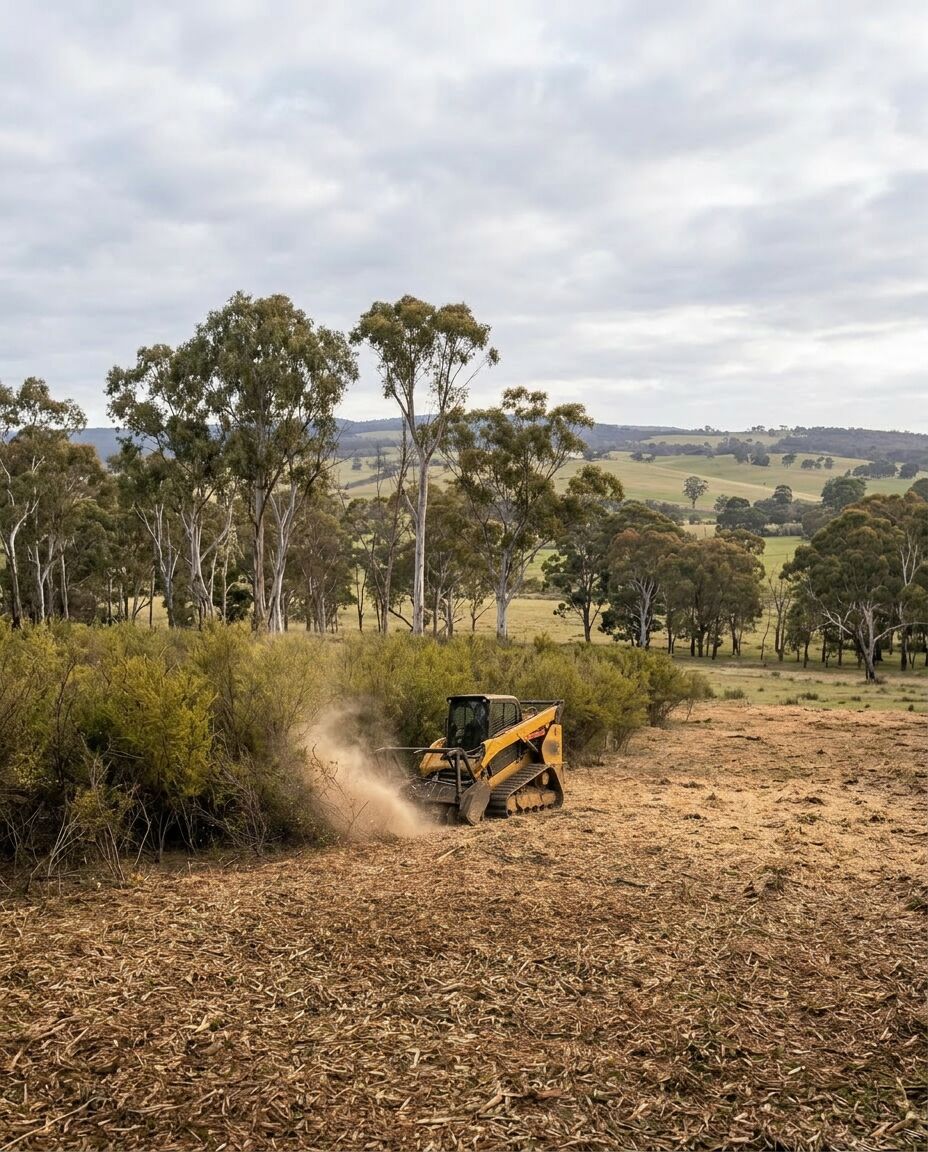
Forestry Mulching.
What This Means
Scrub, regrowth and unwanted timber processed where they stand, with mulch retained on site.
We cut scrub, saplings, blackberry, gorse and unwanted timber and mulch it where it stands. The cleared vegetation stays on-site rather than being burnt or carted away. That mulch layer can help retain moisture, cover exposed ground and suppress some new growth as it breaks down.
Forestry mulching clears vegetation at ground level, so stumps and roots stay in place. Where below-ground timber prevents the next use of the land, subsoil mulching and land reclamation can be assessed separately. Book forestry mulching on its own, or ask about below-ground work now or later. Each service has its own agreed scope. Trees you want kept, stay. Very dense growth can need a second pass.
Bendigo based, working across Central Victoria, and Victoria-wide for larger-scale projects.
The right machine gets brought in for the job, usually a tracked skid steer with a drum mulching head. A disc method can be assessed for suitable larger stems, subject to equipment availability and site conditions. Tracks spread the weight, but machinery can still disturb the ground. Access and slopes are assessed on-site; saturated ground waits for a dry window.
Output depends on density. Light regrowth moves quickly, mature blackberry, gorse or heavy timber is slower and often wants a second pass to bring the finish down further. We walk the property with you first, mark what stays, flag anything protected, and give you a straight timeframe before we start.
The Challenge
Dense Vegetation. Difficult Ground.
Forestry mulching is straightforward on open, even country. Most properties are neither. These are the conditions that determine how the work is planned and carried out.
- 01
High-Density Vegetation
Thick scrub and standing timber determine the pace of the work. Dense areas are processed at the rate the material allows, keeping the finish consistent across the site.
- 02
Mulch Layer Management
Processed material remains on site as a ground layer. At the correct depth it retains moisture and slows regrowth; excessive depth can smother pasture. Depth is managed during the work, not corrected afterwards.
- 03
Concealed Wire and Debris
Old fence wire and dumped material within regrowth can destroy a mulching head. Fence lines are inspected before work begins, and uncertain areas are worked around until their contents are known.
- 04
Soft Ground and Steep Slopes
Wet flats and steep country require tracked machines. Equipment is matched to ground conditions rather than pushing on and damaging the property.
- 05
Subsurface Obstructions
Buried stumps, rock and timber only become visible once the machine reaches them. Rough country is worked at a controlled pace to protect the ground and the equipment.
- 06
Retained Vegetation and Boundaries
Trees and fence lines to be retained are marked before work begins. Working around them is slower, and they remain undamaged at completion.
Solutions
What we can do for you.
We supply the right machinery for the job. You tell us what the land needs, we work out the method.
Plantation Mulching
Harvest residue, wildlings and old plantation rows mulched back for replanting or conversion.
Scrub & Regrowth Mulching
Dense scrub and saplings cut down and left on the ground as mulch.
Selective Clearing
Trees and vegetation that stay are marked first and worked around.
Fence Line & Boundary Mulching
Lines opened up ready for new fencing or maintenance access.
Woody Weed Mulching
Suitable blackberry, gorse and broom mechanically reduced; regrowth may require follow-up.
Track & Easement Mulching
Access tracks, easements and breaks cleared back by machine.
Large-Scale Plantation Works
Whole plantation compartments and harvest areas mulched under contract for forestry companies and landholders.
Machinery
Choosing the right machinery for the job.
Machinery selection is based on the vegetation, site access and the finish agreed with you.
Our experienced operators use machinery and attachments suited to the work. We assess the site and confirm the equipment and method before work begins.
Tracked skid steers
Forestry mulching heads
Tractors with PTO mulchers
Brushcutter attachments
Mulch it here. Keep it on the land.
No burn piles and no haul-away of the mulched vegetation. The useful benefits come from keeping ground cover and choosing what to clear carefully.
- 01On-site processing avoids burning the cleared vegetation and the smoke that comes with it. It also avoids carting that material away for disposal.
- 02A retained mulch layer can help shade the ground, hold moisture and reduce exposure to erosion. The result depends on the site, mulch coverage and the weather.
- 03Woody material returns organic matter as it decomposes. That is not a promise of instant fertility, pasture improvement or habitat restoration.
- 04Selective clearing keeps agreed trees and vegetation outside the work area. Native vegetation, planning overlays and permit requirements are checked before clearing; mulching is still vegetation removal.
- 05Ground-level mulching leaves stumps and roots in place. Machinery can still disturb the ground, and blackberry, gorse and other weeds may need follow-up management. Reduced standing vegetation is not a guarantee of bushfire protection.
If Left Unchecked
What another year costs you.
Most people put this work off one more season. Here's what actually happens when you do, straight, no fearmongering.
Read the full breakdown →- 01Dense scrub is ladder fuel, it carries a ground fire up into the tree canopy where it becomes uncontrollable.
- 02Every season left, regrowth thickens and the job gets bigger. What's a straightforward mulch today becomes a multi-day clear next year.
- 03Blackberry and woody weeds set deeper roots and spread further, making chemical follow-up harder to hold.
- 04Once a fire hits scrub-choked country, trucks can't get in and crews can't defend from inside it.
Do I need approval before forestry mulching?
Mulching is vegetation removal even when material stays on-site. Confirm native vegetation, overlays, habitat, waterways and title conditions for the marked work area. Provide required approvals or written confirmation of an applicable exemption before starting.
Can forestry mulching handle concealed wire or rubbish?
A mulching head must not be used to process wire, metal, rubbish or unidentified infrastructure. Identify known hazards before the site visit and agree how they will be made safe. Work in an affected area may stop if concealed material is exposed; any changed scope is agreed before proceeding.
What is forestry mulching?
Forestry mulching cuts standing scrub, regrowth, blackberry and unwanted timber into mulch that stays on the ground. A drum head is commonly used; a disc method may suit some larger stems, subject to availability and site assessment. No burning or haul-away of the mulched vegetation. The mulch can help cover the ground and retain moisture as it decomposes. It cuts vegetation at ground level; it does not remove stumps or roots.
What can forestry mulching clear?
Dense scrub, saplings, blackberry, gorse, woody weeds and suitable unwanted timber up to the chosen head's capacity. The method depends on stem size, access and what needs to stay. A disc method may suit larger stems but is assessed separately and subject to availability. Retained trees and protected vegetation are marked before work starts.
What happens to the vegetation after mulching?
It stays on-site as a mulch layer. Coverage and depth depend on the vegetation and agreed finish. As it breaks down it returns organic matter and can help retain moisture and suppress some new growth. It does not stop established woody weeds returning, so follow-up management may be needed.
Is forestry mulching better than burning or bulldozing?
It depends on the property and the intended finish. Mulching avoids burning the cleared vegetation and can leave ground cover without uprooting stumps and roots. It can involve less disturbance than grubbing vegetation out, but machinery still affects the ground. No burning does not mean no clearing permit: native vegetation and overlays still need checking. Below-ground timber can be assessed separately for subsoil work where suitable.
Is forestry mulching an eco-friendly way to clear land?
It has practical environmental benefits where clearing is appropriate: no burning of the mulched vegetation, no haul-away of that material, and retained mulch that can help cover the ground and hold moisture. It is not impact-free, carbon-neutral or habitat restoration. Machinery can disturb the ground; native vegetation may need approval and weeds often need follow-up. We assess the method and what needs protecting on the site visit.
What should I do after forestry mulching?
Retain ground cover where it suits the next use of the land, and monitor for regrowth. Blackberry, gorse and other declared weeds need a follow-up plan, with any chemical treatment carried out by a suitably qualified person at the appropriate time. Planting and pasture establishment may need further preparation. Mulching is not engineered site preparation and does not make land ready to build on.
Do you travel outside Bendigo for forestry mulching?
Yes. We're based in Bendigo and work across Central Victoria as standard, and Victoria-wide for larger-scale projects. We'll come out, walk the property and give you an honest on-site quote.
How much does forestry mulching cost?
It depends on the density of the scrub, the size of the area, access and the terrain, which is why we don't quote over the phone. We come out, walk the property with you, and put the whole job and price in writing before anything starts.
Will the mulcher tear up my paddock?
Tracks spread the machine's weight, and retained mulch can help protect exposed ground, but no machine is impact-free. We assess access, slopes and ground conditions first and avoid working saturated ground. The likely disturbance and finish are discussed on-site rather than promising an untouched paddock.
Do I need to be home while you're working?
No. Most of our rural clients aren't there on the day. We walk the property with you first, agree the scope in writing, then get on with it. You get a call when it's done and we walk the finished job with you when it suits.
What's the best time of year to mulch?
Timing depends on machinery access, vegetation, approvals and current fire restrictions. Plan assessment and approvals early, then schedule work when the site can be accessed safely. Ironbark does not work on Total Fire Ban days; unsuitable ground or other unsafe conditions can also delay work.
Do you spray weeds as well?
Not yet. Commercial weed spraying needs a Commercial Operator Licence (COL) from Agriculture Victoria and Ironbark is arranging it now — spraying starts once the licence is in hand. Mechanical clearing and slashing are available today, and chemical follow-up can be arranged with a licensed contractor in the meantime.
Ready to get started?
Tell us what the job involves. We'll visit the site, assess the work and provide a written quote, with no obligation.